Friday, 14 June 2019

Quandary - Measuring value and success


I’m in Uganda, catching up on a number of projects that I’m linked to through CRED, and more importantly catching up with a number of folks who are involved in those projects in various ways. Many of these folks make up my ‘Ugandan family’ and its always a joy to come out and spend time with them.
Yesterday one of the conversations led to us wrestling with the dilemma of how to measure the value and success of project, resulting in the following train of thought.

When it comes to the secular viewpoint, success is measured in quantifiable outcomes – number of people fed, number of children attending school, numbers, numbers, numbers. And value is measured in success versus money invested, so again its all about numbers and profit margins and budget spreadsheets.

And that’s all fine, and I totally get why some organisations and donors have to work that way. But as a Christian, working with projects that have a strong underlying faith element, where the focus is as much on the few as the many – these methods of measuring value and success just don’t stack up. And when they are applied to a project, the outcomes can mean that the project may look like it has failed, or at least not performed very well, due to the low numbers of people impacted.

But the quality of impact on those people can be really high and surely that is as much a measure of success as the number of people impacted. 

Take the Acholi programmes – the children we are helping to go to school will probably never be in a position to pay back the money that has been invested in their education, but as a result of selfless giving on the part of donors, those children do have the chance to learn, and get better jobs, and work their way out of poverty. They are being given hope. They are discovering that they aren’t forgotten. They are learning that they have value just like children from richer backgrounds.

And then there is the vocational training college – built in a rural bit of Uganda where the community felt ignored and where opportunities were almost nil. Investment in the area had come no closer than the town on the main road, it certainly wasn’t reaching into the rural areas, and so the local folks felt as though they had no worth.
But take the risk of putting a college there and suddenly the community feel significant, and valued, and listened to.

Those are the value of God’s Kingdom being put into action - values which essentially turn manmade values on their head and puts the last first, the weakest above the strongest, the vulnerable above the secure and the voiceless above the voiced. Those are projects where lives are transformed; where hope is given when before there was none; where those who felt ignored, unvalued and insignificant change to feeling listened to, valued and worthy; where risks are taken on behalf of those who are unlikely to ever be able to pay back in real terms

I’m not for one moment implying that this isn’t happening elsewhere. And I know that there are many folks cleverer than me who can work out how to show Kingdom values in a way that keeps secular donors happy. And indeed, there are programmes taking place across the world where Kingdom values are being shown but without the programme makers recognising them in this faith-related way.

But the conversation yesterday was a good reminder of how important it is to see each individual for who they are, and for what the programme means for them, and what they are getting out of it, without getting trapped into the numbers game. God is about names not numbers, God is about faith, and hope, and love. And the more we can show that in the everyday, the more we can help demonstrate that God’s Kingdom isn’t something just for the future, but that it is here and now, and we are invited to be part of it.

Monday, 15 April 2019

When I was at Entebbe airport.....

When I was at Entebbe airport the other evening, waiting to fly to Kenya, I watched passengers checking in for a flight bound for Dubai.
Some were clearly seasoned passengers, possibly connecting to flights to other parts of the world; some were dressed in clothing that shows they are from Middle East.
 
But the heartbreaking aspect for me were how many of the passengers were teenage girls, all dressed in identical clothing, almost like a uniform - wearing T-shirts advertising the recruitment agency that had signed them up, a long plain beige skirt and a yellow headscarf covering all hair
The girls wore expressions that were a mix of apprehension and excitement at the ‘adventure’ ahead. They clearly hadn’t flown before. 
 
What sort of adventure will it turn out to be? Will it be one they enjoy, or will it turn out to be a time of false promises, quashed dreams, and worse?
I hope I’m wrong- I hope they have a good time, and return to their families with all expectations achieved. 
 
Unfortunately the cynic or the realist in me suspects otherwise and the concepts of human trafficking, domestic servitude and child brides come to mind. 
 
Could I have done anything? Not really, not there in the airport. Nothing except pray, which is what I did, and continue to do. 
 
So I am praying for those girls, and others like them all over the world who are lured away from home, education and safety by stories of quick money, employment, travel and opportunities to escape poverty, but soon discover that the reality is horribly different from all that. 
 
And praying for all those organisations around the world who work tirelessly to bring an end to these awful practices- oh that one day the need for such organisations will no longer exist. 
 

Saturday, 6 April 2019

News from Acholi Quarters

Sometimes my role within Acholi Quarters is about introducing new people to the community. Sometimes it's about following up on previous links made. Sometimes it's just about catching up with friends who increasingly feel like part of my Ugandan family.
Most of the time it's a combination of all of the above.

So yesterday and today I have had the joy of introducing new folks to the community, following up on a link set up between the Hopeful Haven 'educational day care' and a primary school in Birmingham, and catching up with Harriet, Miriam, and many of the other ladies that I am delighted to call my friends out here. 

The new folks were two friends from Thornbury and their 9 year old sons. Yesterday we did some activities with the children in Hopeful Haven, looked round the community and had a lovely bit of time being shown how to make beads by the Acholi ladies. Sitting together in the shade of a building, rolling paper into beads is a very beautiful way to forget our differences and to just enjoy the experience of harmony and co-production

Today the focus was the 4th Mercy scout group - the two lads from UK are both from local cub groups, and so the time together was a real demonstration of the International nature of Scouting.

For the Thornbury lads, it was the chance to see a very different scouting set up - lots of drilling and parading, almost no equipment, no scout hut, no uniform to call their own, but even so a sense of belonging to something bigger than the impoverished community in which they live.

For the 4th Mercy scouts, it was the chance to meet some other youngsters their age, from the UK, and who were also wearing neckerchiefs, and who are part of the same international movement.

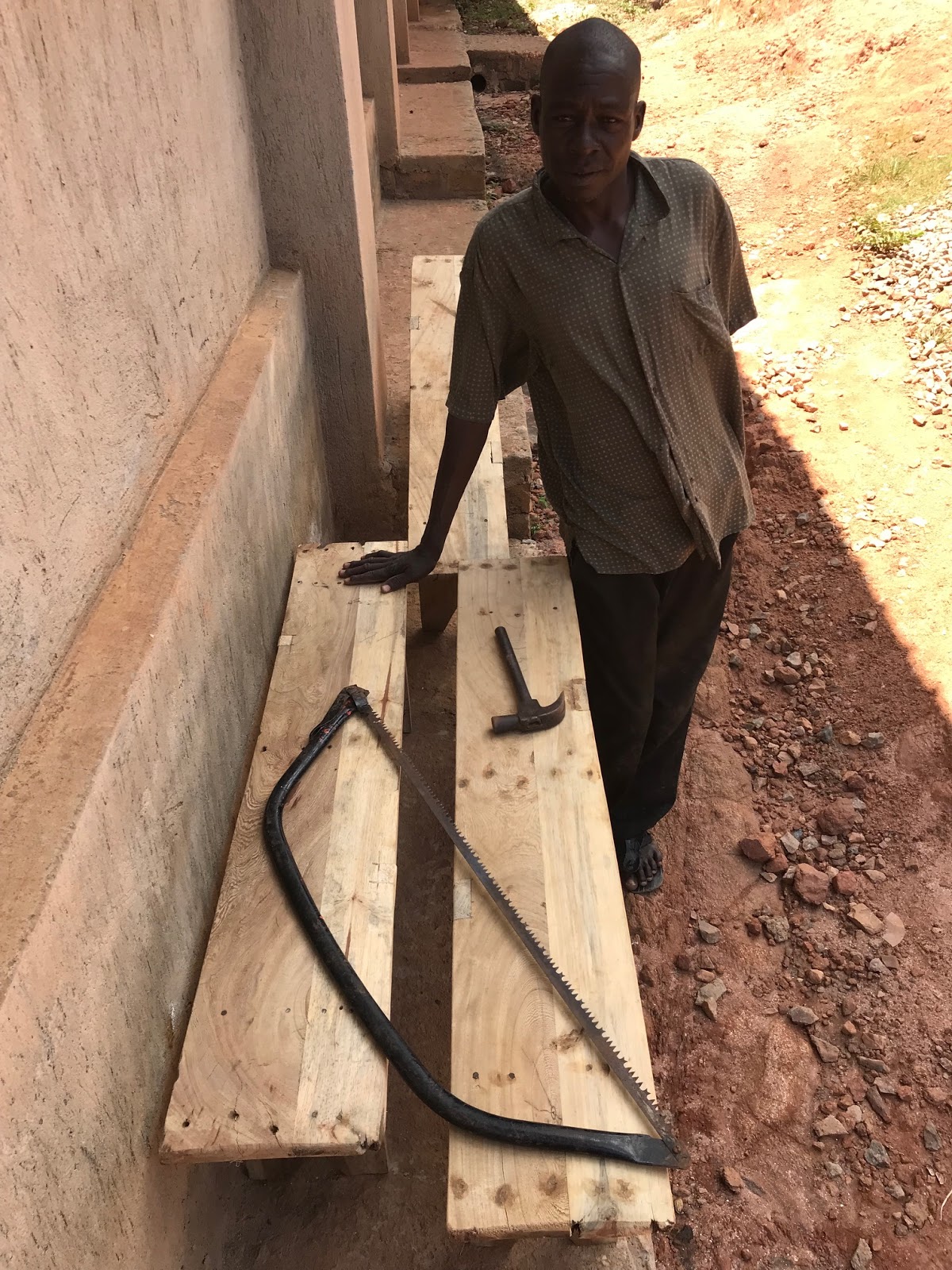
Yesterday also included seeing the delivery of some new benches for the children at Hopeful Haven, made by John who is a local carpenter in the Acholi community. The money was raised by the Birmingham school, and as a result of having the benches the children will no longer have to choose whether to use the bench as a bench or a desk - there's enough to have both!

It might all seem like little steps and trivial moments, but all those moments add up, and it's a privilege to be part of that.

Not long ago the Hopeful Haven didn't exist, and nor did the scout group. Now they do, and the Acholi children have the chance to think wider than just the here and now of survival and existence.

For the ladies also, those moments of sitting together and chatting, laughing and sharing, are precious times of sisterhood, of celebrating each other, of knowing that no-one is alone, and that we have each other in our hearts.

They are wonderful moments - of building bridges, of creating relationships, of letting the other (whether UK or Ugandan other) know that we are together, and that together we are stronger.

Looking forward to many more such moments!


Wednesday, 3 April 2019

WBA - taking it to counsellors and clergy


For a year or so now, I’ve been supporting John Njendahayo and the Vocational Training College that he has set up, as they seek to embed the concept of ‘Whole Brain Approach to Teaching and Learning’ into the heart of all that they do.

The college opened March 2018, and WBA has been within the ethos from the start. My role has been to support the staff in this, and to provide input and resources and training, to equip them to incorporate WBA in all aspects of college life.

It’s been a wonderful journey of learning for all – me re cultural context of embedding the concept, the staff re learning about a totally new way of thinking about teaching and learning, and the students re finding out more their different learning preferences and how to maximise on that knowledge to get the most out of their studies.

We aren’t there yet, but we are all on the journey together, and I love it.

Last week, I had the opportunity to take WBA to a new audience – the I Live Again Uganda team in Gulu who have trauma counselling as their focus. They work with those who continue to suffer the after-effects of living through the horrors of the LRA atrocities and are now starting to work with Sudanese refugees as well.

It was both wonderful and exciting to see the ILA team embracing the WBA concept so well, and exploring ways in which it can be applied to their work – both regarding team dynamics for the staff, and also relating to mental health therapies for people that they work with. The upshot was that I’ve been asked to return and do longer training, with them, and also with some other interested groups.

And then today I had the delightful task of giving a presentation on WBA to a group of clergy who were predominantly from the Church of Uganda. Having the opportunity to link it to Biblical texts and faith-based thinking was a real privilege, and again the workshop participants lapped up the information with great enthusiasm.

Next week I am doing some more training at the college, and then the following week I am taking it to a CRED Partner in a school in Kenya. 

I don’t know where all this will ultimately lead, but that’s fine – God does, and I’m happy to leave it with Him. For now, I’m just delighted to be able to take this information and new way of viewing ourselves and those with whom we interact, work and live, and offer it to others, that they also may be enriched through discovering process.